


As a dedicated supplier of stamping brackets, I often encounter various technical inquiries from clients, and one question that has piqued my interest recently is: What is the Poisson's ratio of a stamping bracket? In this blog, I'll delve into the concept of Poisson's ratio, its significance in the context of stamping brackets, and how it impacts the performance and design of these essential components.
Understanding Poisson's Ratio
Poisson's ratio, denoted by the Greek letter ν (nu), is a fundamental mechanical property that describes the relationship between the transverse strain and the axial strain of a material when it is subjected to an external force. When a material is stretched or compressed along one axis (the axial direction), it will typically contract or expand in the perpendicular directions (the transverse directions). Poisson's ratio quantifies this behavior and is defined as the negative ratio of the transverse strain to the axial strain:
ν = -ε_transverse / ε_axial
where ε_transverse is the transverse strain and ε_axial is the axial strain. The negative sign is included to ensure that Poisson's ratio is a positive value, as the transverse strain and axial strain have opposite signs (e.g., when a material is stretched axially, it contracts transversely).
Poisson's ratio is a dimensionless quantity that ranges from -1 to 0.5 for most engineering materials. A value of 0.5 indicates that the material is incompressible, meaning that its volume remains constant when subjected to deformation. On the other hand, a value of -1 would imply that the material expands in the transverse directions when stretched axially, which is not physically possible for most materials.
Poisson's Ratio in Stamping Brackets
Stamping brackets are widely used in various industries, including automotive, aerospace, and construction, to provide support, reinforcement, and connection between different components. These brackets are typically made from metal sheets through a stamping process, which involves applying a high force to shape the metal into the desired form.
The Poisson's ratio of the material used to manufacture stamping brackets plays a crucial role in determining their mechanical behavior and performance. When a stamping bracket is subjected to an external load, such as tension, compression, or bending, the material will deform according to its Poisson's ratio. This deformation can affect the bracket's shape, dimensions, and strength, as well as its ability to withstand the applied load without failure.
For example, consider a stamping bracket that is designed to support a heavy load in tension. If the material has a high Poisson's ratio, it will contract more in the transverse directions when stretched axially, which can lead to a reduction in the bracket's cross-sectional area and an increase in its stress concentration. This, in turn, can make the bracket more susceptible to failure, such as cracking or yielding. On the other hand, a material with a low Poisson's ratio will experience less transverse contraction, resulting in a more stable and reliable bracket.
In addition to its impact on the bracket's mechanical behavior, the Poisson's ratio can also affect the stamping process itself. During stamping, the metal sheet is subjected to significant deformation, and the material's Poisson's ratio can influence the flow of the metal and the formation of the final shape. A material with a high Poisson's ratio may require more force to deform, and it may be more prone to wrinkling or cracking during the stamping process. Therefore, selecting a material with an appropriate Poisson's ratio is essential to ensure the successful production of high-quality stamping brackets.
Factors Affecting Poisson's Ratio
The Poisson's ratio of a material is influenced by several factors, including its chemical composition, microstructure, and manufacturing process. Different metals and alloys have different Poisson's ratios due to their unique atomic structures and bonding characteristics. For example, steel typically has a Poisson's ratio of around 0.3, while aluminum has a value of approximately 0.33.
The microstructure of the material, such as its grain size, orientation, and phase distribution, can also affect its Poisson's ratio. For instance, a material with a fine-grained microstructure may have a different Poisson's ratio compared to a material with a coarse-grained microstructure. Additionally, the manufacturing process used to produce the stamping brackets, such as cold rolling, hot rolling, or annealing, can alter the material's microstructure and, consequently, its Poisson's ratio.
Importance of Selecting the Right Material
As a stamping bracket supplier, I understand the importance of selecting the right material for each application. The choice of material depends on various factors, including the required strength, stiffness, corrosion resistance, and cost. However, the Poisson's ratio of the material should also be taken into consideration to ensure the optimal performance and reliability of the stamping brackets.
When selecting a material, it is essential to consider the specific requirements of the application, such as the type and magnitude of the applied load, the operating environment, and the desired lifespan of the brackets. Based on these requirements, a material with an appropriate Poisson's ratio can be chosen to ensure that the stamping brackets can withstand the applied load without excessive deformation or failure.
In addition to the Poisson's ratio, other mechanical properties, such as Young's modulus, yield strength, and ultimate tensile strength, should also be considered when selecting a material for stamping brackets. These properties, along with the Poisson's ratio, determine the material's overall mechanical behavior and its suitability for the intended application.
Our Product Range
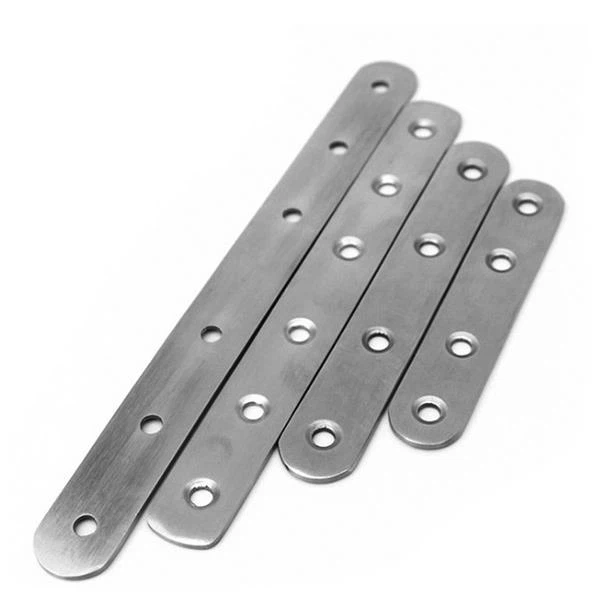
At our company, we offer a wide range of stamping brackets to meet the diverse needs of our customers. Our product portfolio includes Flat Support Bracket, Stamping Bracket, and Heavy Duty Steel U Brackets, among others.
We use high-quality materials with carefully selected Poisson's ratios to ensure the excellent performance and reliability of our stamping brackets. Our experienced engineers and technicians work closely with our customers to understand their specific requirements and provide customized solutions that meet their exact needs.

Contact Us for Procurement
If you are in the market for high-quality stamping brackets, we invite you to contact us for procurement and further discussion. Our team of experts is ready to assist you in selecting the right material and design for your application, as well as providing you with competitive pricing and excellent customer service.
Whether you need a small batch of custom-made stamping brackets or a large-scale production run, we have the capabilities and resources to meet your requirements. We are committed to delivering the highest quality products on time and at a reasonable cost, and we look forward to the opportunity to work with you.
References
- Callister, W. D., & Rethwisch, D. G. (2017). Materials Science and Engineering: An Introduction. Wiley.
- Ashby, M. F., & Jones, D. R. H. (2012). Engineering Materials 1: An Introduction to Properties, Applications, and Design. Butterworth-Heinemann.
- Dieter, G. E. (1988). Mechanical Metallurgy. McGraw-Hill.