


What is the impact of cutting forces on CNC machining parts?
Hey there! I'm a supplier of CNC machining parts, and today I want to talk about the impact of cutting forces on the parts we make. Cutting forces play a huge role in the CNC machining process, and understanding them can really help us produce high - quality parts.
First off, let's understand what cutting forces are. When a cutting tool, like an end mill or a drill bit, interacts with the workpiece during CNC machining, there are forces generated. These forces can be divided into three main components: the cutting force in the direction of the cutting speed, the feed force in the direction of the tool feed, and the radial force perpendicular to the cutting and feed directions.

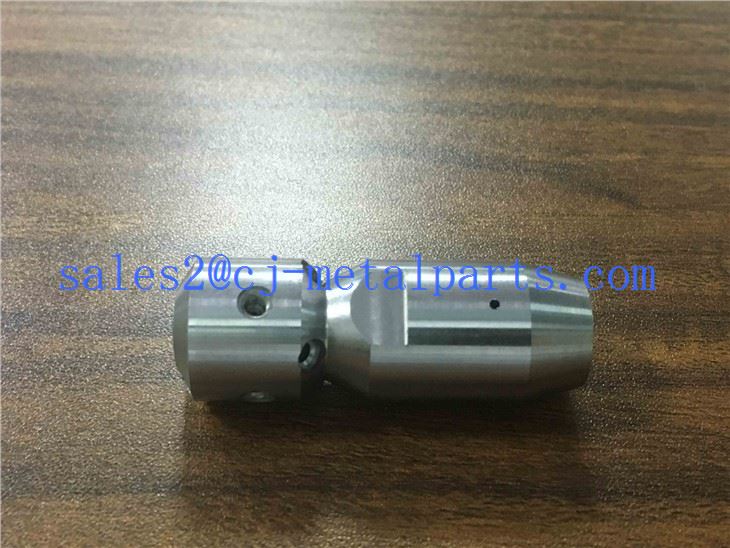
One of the most obvious impacts of cutting forces is on the dimensional accuracy of the CNC machining parts. Excessive cutting forces can cause the workpiece to deform. Imagine you're trying to cut a thin sheet of metal. If the cutting force is too high, the sheet might bend or warp. This means that the final part won't have the exact dimensions specified in the design. For example, if you're making a precision component for an electronic device where every millimeter matters, any deformation due to high cutting forces can render the part useless.
Surface finish is another area that's greatly affected by cutting forces. When the cutting forces are well - controlled, the cutting tool can smoothly remove material from the workpiece, leaving a nice, smooth surface. But when the forces are too high, it can lead to chatter. Chatter is like when your hands shake while you're trying to write neatly. In CNC machining, it causes uneven cuts and a rough surface finish. A rough surface finish is not only aesthetically unappealing but can also affect the functionality of the part. For instance, in a part that needs to seal against another component, a rough surface might prevent a proper seal, leading to leaks.
Tool life is also closely related to cutting forces. High cutting forces put a lot of stress on the cutting tool. This stress can cause the tool to wear out faster. Just like how a pair of shoes will wear out more quickly if you constantly run on rough terrain, a cutting tool will wear out faster under high cutting forces. When a tool wears out, it doesn't cut as effectively, which can further increase the cutting forces and create a vicious cycle. Eventually, the tool will become dull and need to be replaced. Constantly replacing tools can be costly and can also slow down the production process.
Now, let's talk about how we, as a CNC machining parts supplier, deal with these issues. We use advanced toolpath planning software. This software helps us optimize the way the cutting tool moves across the workpiece. By carefully planning the toolpath, we can reduce the cutting forces. For example, we can choose the right feed rate and cutting speed to ensure that the tool removes material in the most efficient way possible.
We also select the right cutting tools for the job. Different materials require different types of cutting tools. For example, when machining stainless steel, we need a tool that can withstand the high hardness and toughness of the material. Using the wrong tool can result in excessive cutting forces and poor - quality parts.
Another important aspect is the use of proper fixturing. Fixturing is like holding a piece of paper firmly when you're trying to cut it with scissors. In CNC machining, a good fixture holds the workpiece securely in place. This helps to distribute the cutting forces evenly across the workpiece and prevents it from moving or vibrating during the machining process.
Let me give you an example of a product we offer, the Stainless Steel Machined Spray Nozzle. When manufacturing this nozzle, we have to be extremely careful about the cutting forces. The nozzle has very precise holes and a smooth inner surface. If the cutting forces are not controlled, the holes might not be the right size, and the inner surface could be rough. This would affect the spray pattern and the efficiency of the nozzle.
In conclusion, cutting forces have a significant impact on CNC machining parts. They affect dimensional accuracy, surface finish, and tool life. As a supplier, we take various measures to control these forces to ensure that we produce high - quality parts. If you're in the market for CNC machining parts, whether it's a Stainless Steel Machined Spray Nozzle or any other custom - made component, we're here to help. We have the expertise and the technology to handle all your machining needs. If you're interested in our products and want to discuss your specific requirements, don't hesitate to reach out to us. We're always ready to have a chat and see how we can work together to get you the best - quality CNC machining parts.
References:
- Boothroyd, G., & Knight, W. A. (2006). Fundamentals of machining and machine tools. CRC Press.
- Kalpakjian, S., & Schmid, S. R. (2010). Manufacturing engineering and technology. Pearson.