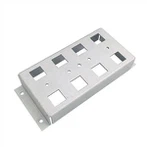
Milling Parts Process
Milling is a cutting process that uses a milling cutter to remove material from the surface of a workpiece. A milling cutter is a rotary tool that usually has multiple cutting points. In contrast to drilling, in which the tool advances along its axis of rotation, the tool in milling generally moves perpendicular to its axis, so cutting occurs on the circumference of the tool. As the milling cutter enters the workpiece, the cutting edge (grooves or teeth) of the tool repeatedly cuts in and out of the material, scraping off chips (chips) from the workpiece with each pass. The cutting action is shear deformation; material is pushed off the workpiece in tiny clumps that hang together to a greater or lesser extent (depending on the material) to form chips. This makes metal cutting somewhat different (in its mechanics) from slicing softer materials with a blade.
The milling process removes material by performing many separate, small cuts. This is accomplished by using a cutter with many teeth, spinning the cutter at high speed, or advancing the material through the cutter slowly; most often it is some combination of these three approaches . The speeds and feeds used are varied to suit a combination of variables. The speed at which the piece advances through the cutter is called feed rate, or just feed; it is most often measured in length of material per full revolution of the cutter.
There are two major classes of milling process:
In face milling, the cutting action occurs primarily at the end corners of the milling cutter. Face milling is used to cut flat surfaces (faces) into the workpiece, or to cut flat-bottomed cavities.
In peripheral milling, the cutting action occurs primarily along the circumference of the cutter, so that the cross section of the milled surface ends up receiving the shape of the cutter. In this case the blades of the cutter can be seen as scooping out material from the work piece. Peripheral milling is well suited to the cutting of deep slots, threads, and gear teeth.